Shenyang
Shenyang is the largest city in the north-eastern region of China, and serves as the capital city of Liaoning Province. This city is the gateway toward the Manchurian section of China, rich in untapped natural resources.Manchurians are ethnically different from Chinese, even though most of them claim to be Han (pure) Chinese these days. Russians and Japanese attempted to control this city from 1895 to 1945. Since Manchurians and Koreans share the same ethnic root, there are many Koreans in this city and surrounding areas.
- Since Manchurians are different, there have been many attempts
for them to set up their own country independent of China. Their
desire for independence used to became stronger whenever the central
government of China became weaker.
Indeed, those people were able to set up their own empire called "Jin" (meaning gold) in 1127, independent of China's central authority of the Song Dynasty. This Manchurian empire lasted for 152 years until it was annexed to the Yuan Dynasty in 1279. Yuan (1271-1368) was the Mongolian dynasty started by Genghis Khan.
The Ming Dynasty took over China after Yuan. As this dynasty became corrupt and weak, a Manchurian tribe chief named Nuruhachi (1559-1626) set up a country in Shenyang, and He was quite proud of his Manchurian heritage, and called his country "Later Jin."
- Nuruhachi's throne was inherited by his son named Hong Taiji when
he died in 1626. Hong Taiji started ruling his country long before
his father died.
- Hong Taiji's son, thus Nuruhachi's grandson, moved to Beijing to
take over the Chinese government without military operations (1644).
This became the beginning of the Qing Dynasty, which lasted until Sun
Yatsen's revolution in 1912.
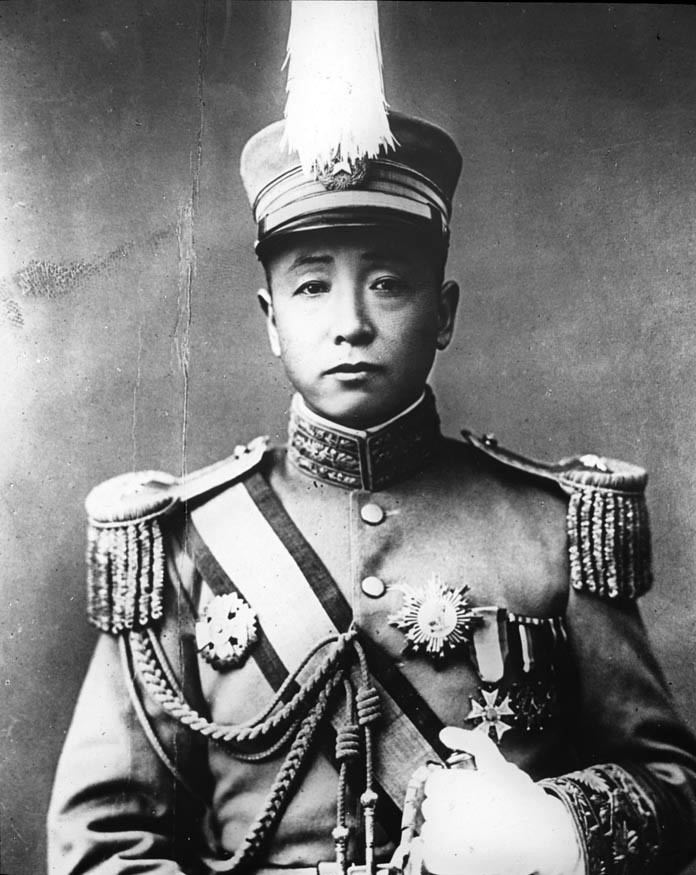
- Toward the end of the Qing Dynasty, a warlord name Zhang Zuolin used Shenyang as his power base, and his army once reached Beijing.

|
| Nuruhachi (1559-1626)(top), and his son, Hong Taiji (1592-1643). |
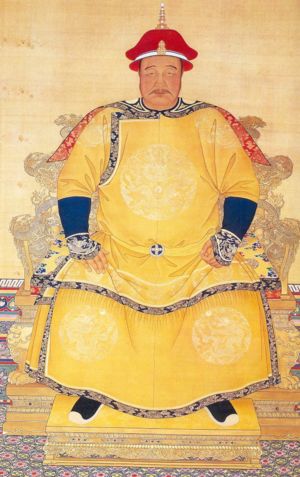
|
- Nuruhachi's Shenyang
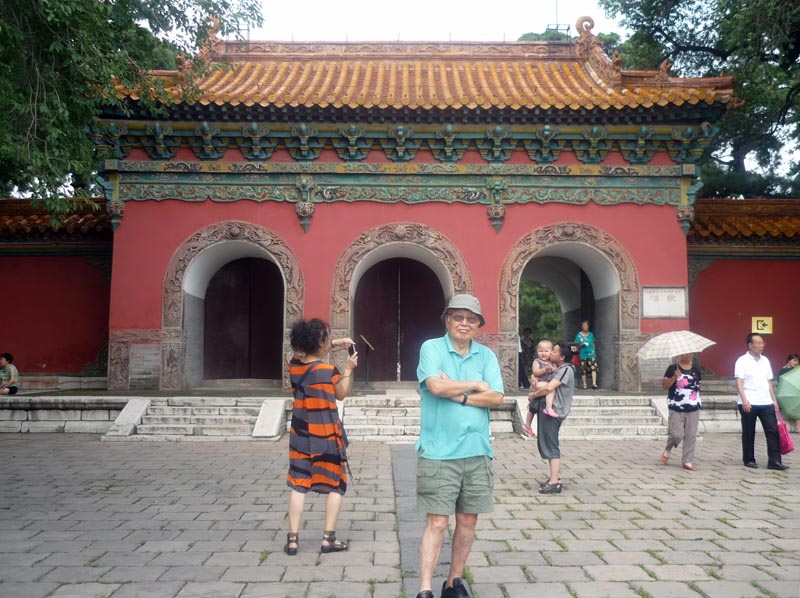
- Front gate to the Nuruhachi Shrine.
- 67 steps to the main shrine. Nuruhachi died when he was 67 years old.
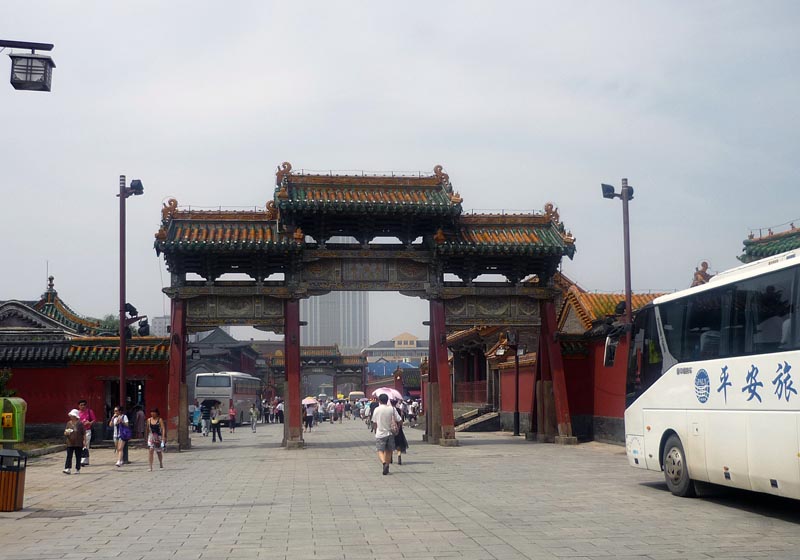
- Gate to the core area of the shrine.
- Nuruhachi's portrait in the shrine.
- Emperor's steps in the shrine. It appears that this shrine was built at the site of Nuruhachi's residence.
- American students. It
was refreshing to meet a group of American students. They are attending
the Middleberry College in Vermont, which is an elite language school.
Presumably, they are spending their summer months to practice their
Chinese. Chinese is a very important language these days.
- Nuruhachi's administrative palace was in a different place. It is now in the middle of the city.
- Entrance to the palace. The golden roof means that the emperor went through the gate.
- Entrance gate to the city. Like all ancient city, Shenyang was walled city with heavy entrance gates.
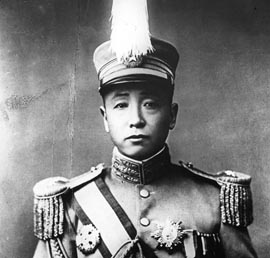
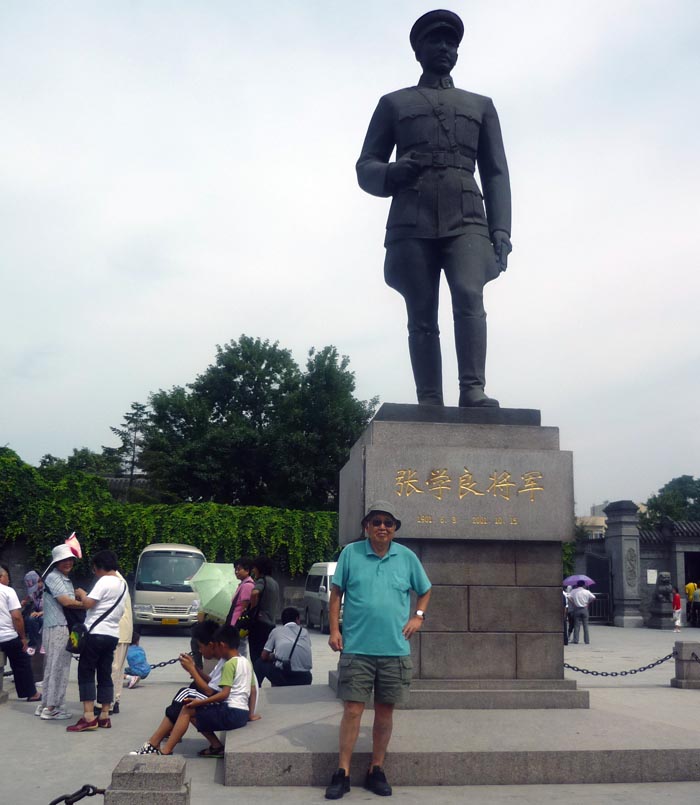
Zhang Zuolin (1875-1927)(top), and his son, Xueliang (1901-2001). 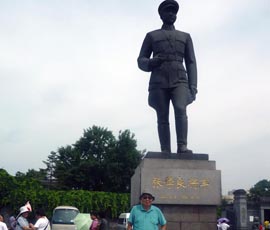
- Zhang Zuolin's Shenyang. Whenever the central government becomes weak,
there is a tendency for military warlords to use Shenyang to
set up their own empires. While Nuruhachi made his case when
the Ming Dynasty became weak around 1600 AD, Zhang Zuolin (1875-1928)
set up his military command Shenyang. In his farewell speech given
at the joint meeting of the U.S. Congress in 1951, Douglas MacArthur
mentioned Zhang's name.
- After Zhang's death in 1928, his son, Zhang Xueliang (1901-2001),
inherited Zhang's military command. Xueliang was in the middle of
power struggles among Chinese, Japanese, and Russians in the
north-eastern area. He was then in the middle of the internal
struggle between the communist and nationalist forces. He had a
great survival skill. He died in Hawaii when he was 101 years old.
Although Xueliang was a general (fighting man), he appears to have
been a great peace maker. We all like peace-making generals.
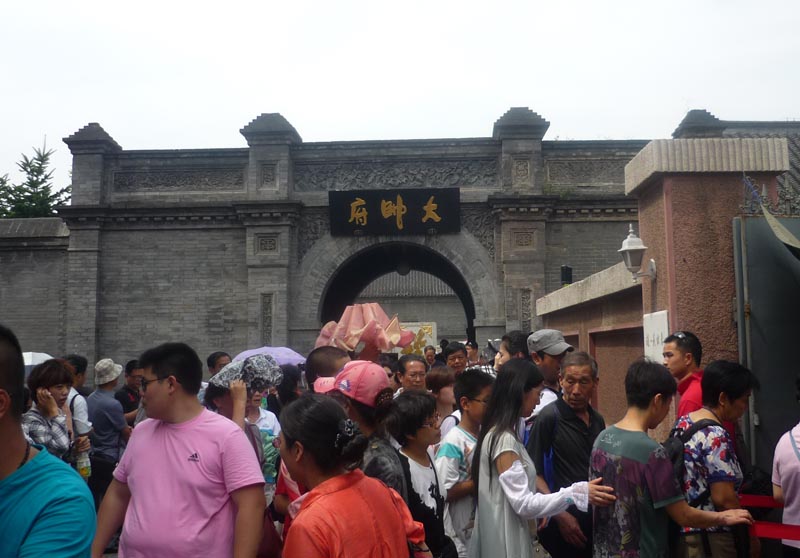
- Zhang family's command. I was there, but I did not have enough time to wait in the line to enter the command compound.
- Entrance to the compound with a long waiting line.
After the Sino-Japanese war in 1895, Japanese expansionists used this city as their power base. They started building railroads throughout Southern Manchuria. Chinese were not so happy with what Japanese were doing. In 1931, a small group of Chinese set up an explosive device to disrupt their construction work. Japanese used this incident as an excuse to send their large military units to this city, and set up their puppet regime for the country called "Manshu Koku." This is widely known as the "Manchurian Incident."


Photo from Wikipedia
- This Wikipedia article gives a more detailed story of this incident. Japanese then started calling this city "Hoten" of "Manshu Hoten."
- This is where Japanese maintained their army headquarters.
- This is the museum dedicated to this 9.18 Manchurian incident in 1931. I was there to take this photo, but did not have time to get into the museum.
During the Manshu-Koku period (1931-45), Shenyang was the headquarters for Japanese military industrial complex. In 1931, Japanese troops came to Shenyang with their Arisaka-38 rifles (diameter 6.5 mm), but they set up a factory there to produce Arisaka-99 rifles (diameter 7.7 mm).
During the civil war (1946-49) between the nationalist and communist armies, the bloody battles took place the Shenyang area. They were both interested in the military establishments left behind by Japanese.
After the communists took over the city, they started producing Japanese-designed Arisaka-99 rifles. During the Korean war (1950-53), Chinese troops came to Korea with those Arisaka rifles produced by Chinese.
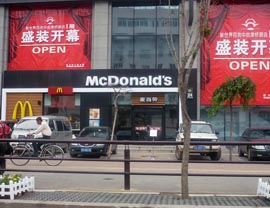
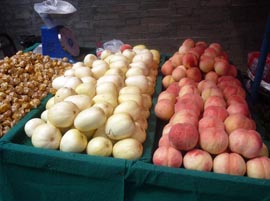

- Shenyang for the people. While politicians and military people play
their games, Shenyang is the city for the people who live there. Let us
see some people-oriented photos.
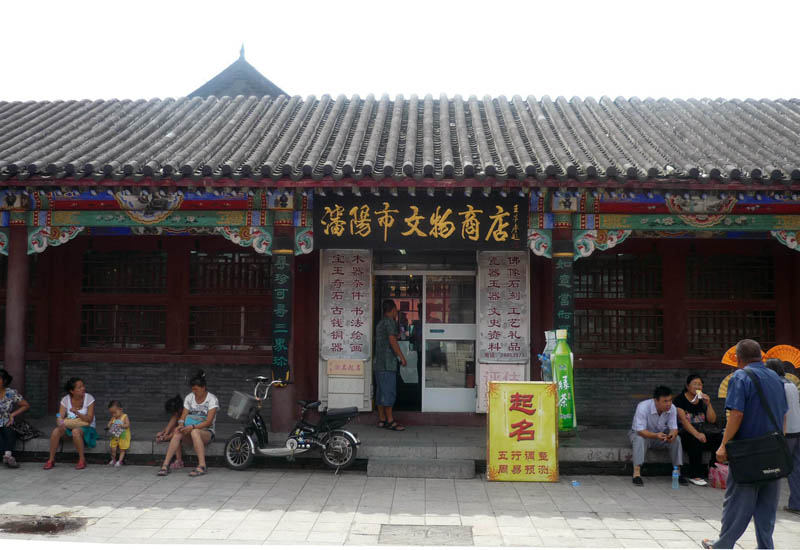
- MacDonald's is there, quite consistent with all other cities in the world.
- Abang Vegetable shop. Abang means Emperor Chin's palace, meaning the ultimate living standard.
- Chinese fruits are like those in all other countries. To me they looked better. They make the people of Shenyang happy.
- One of the convenience stores, like 7&11 Stores in the United States.
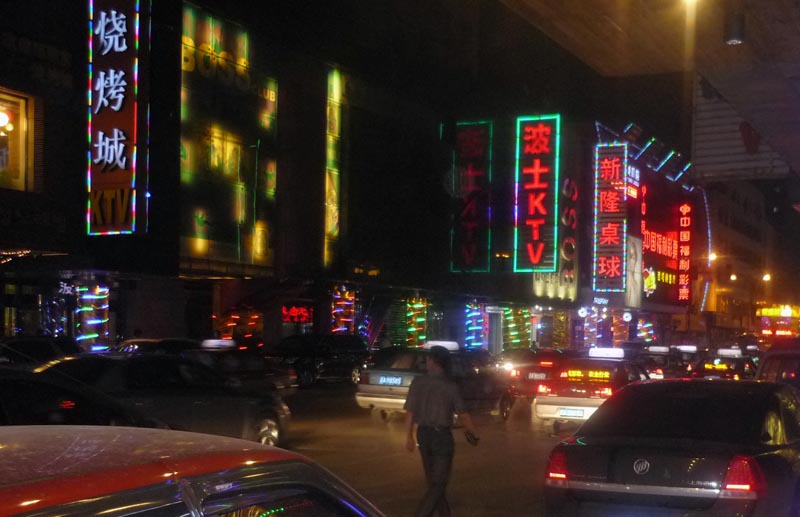
- Main shopping street during the night.
- New office buildings are constantly added to the city. There are many new opportunities opening up in the northeastern area of China.
- Mushrooming apartment buildings are changing the lifestyle of Chinese.
- Mail trucks are like this one. People still write and read letters.
- Shenyang airport is a busy place, and you can meet many interesting people. They cannot speak English but you can still exchange good wills.
- English speaking Chinese. Yet, it is always possible to find a person who could speak English for serious business.
- Security is a major problem even in Chinese airports. These young Chinese are being trained for their job. They speak English.
- There are many Koreans in Shenyang. There is a theory that
Nuruhachi was a descendant of the royal family of Korea's
Silla dynasty. More recently, Koreans in Shenyang organized
their Presbyterian church before those Korean Christians
came to Korea to set up
their first church in 1984.
More recently, many Koreans moved to Manchuria while Korea was occupied by Japanese militarists during the period 1910-1945. These days, many Koreans go there from the South for business purposes. There are also Koreans from the North, because China is ally of North Korea.

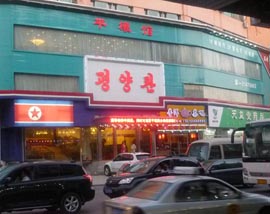
- Korea town. Streets in this are like those Korean cities.
- Korean shop for Korean luxury items.
- Korean hair shops are
very common in China, and Korean hair stylists are working there.
Chinese women like to follow Korean fashions because Korean
women they see from the Korean TV dramas very popular throughout
Asian countries.
- Pyongyang Restaurants.
There are many Northern-style restaurants. I went to
two of those restaurants, and enjoyed talking with their waitresses.
They were all graduates of Pyongyang Commerce College, and with
unquestionable loyalty to Kim Il-Sung and his family. They live
in their restaurant buildings with restricted internet connection.
However, one of them (not in this particular restaurant) became quite interested in my website when I told her I have many photos of girls from all different countries, and I gave my address
I assume she had an occasion to visit my page accessible from China.
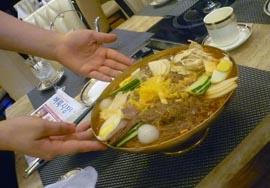
- She was so attractive that I was eager to have a photo with her, but I knew that her government would not allow her to do so. I thus took a photo of her hands holding a Pyongyang warm noodle plate called "Jaengban."
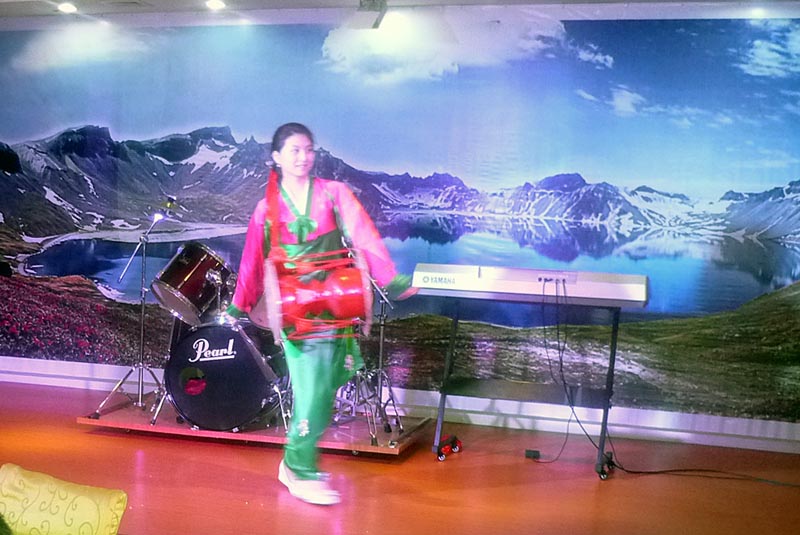
- After-dinner show. North Korean restaurants usually give song-and-dance show after the dinner. All those traditional songs are familiar to Koreans in the South.
- Traditional dances are also included in the show.

|
| |
|








copyright@2013 by Y. S. Kim. Photos are taken by Y. S. Kim or from the public domain, unless otherwise specified. Click here for his home page.