Maxwell and Marconi
Early Days of Korea's Wireless Communication
-
Y.S.Kim (1994.9.5)
-
Lee de Forest was an Edison-type engineer. While he was fooling around with vacuum tubes, he somehow added a grid to one of his tubes. He discovered that the voltage on the grid can change the current from anode to cathode. If you are not familiar with vacuum tubes, he was the man who found out why a transistor has to have three prongs, instead of two. De Forest did not understand how his vacuum tubes (triodes) worked, but was able to set up his broadcasting company 20 times, and went bankrupt 20 times (sometimes after bitter court battles). He had to face the disaster after disaster because he did not understand the competition in business.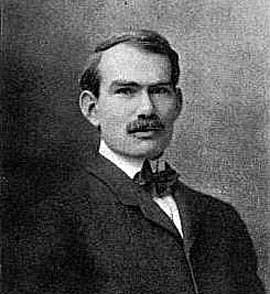

- De Forest's main business rival was Howard Armstrong. He studied
under Professor Michael Pupin (Columbia U's physics building is named
after him) who was America's No. 1 man on Maxwell's equations at that
time. If de Forest gets the credit for inventing vacuum tubes, Armstrong
was the first circuit theorist. He had a clear understanding of de
Forest's triode while de Forest did not understand his own invention.
Thus, Armstrong was able to get ahead by developing circuits where vacuum
tubes serve as components. Indeed, Armstrong was the person who
developed the concepts and techniques of
(a) multi-stage amplification (called regeneration technique).
(b) heterodyne technique (conversion of a high-frequency radio wave to a different frequency while keeping the signal intact).
(c) FM (you should know the difference between AM and FM).
Armstrong developed the regeneration technique before World War I, and the heterodyne and FM during the period between WWI and WWII.
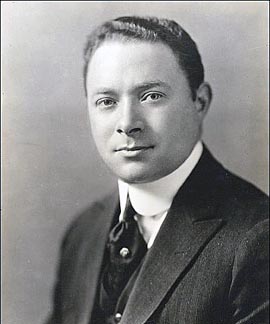
- David Sarnoff was a Jewish immigrant from Russia, and had to deliver newspapers for living before he became Marconi's personal messenger when he was 15 years old. As he grew up, he became Marconi's most trusted manager. Sarnoff was not a scientist, but was able to appreciate Armstrong's inventions. Eventually, Sarnoff hired Armstrong in his own company named RCA (Radio Corporation of America), and used all of Armstrong's inventions for his business purposes. Sarnoff then lost interest in Armstrong and fired him, because he became interested in a new animal called television. After completing the black-white TV, Sarnoff was not satisfied. In 1949, Sarnoff decided to invest 150 million dollars (comparable to Korea's national budget at that time) to the development of color TVs.
|
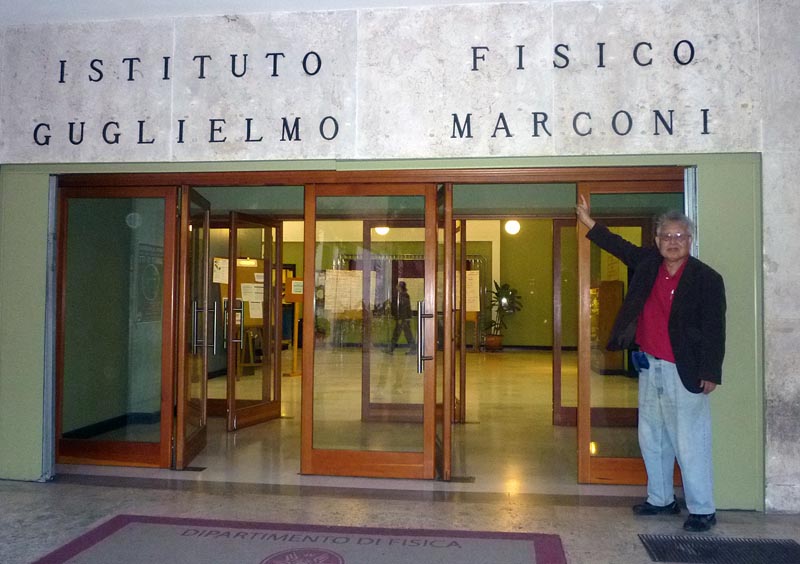
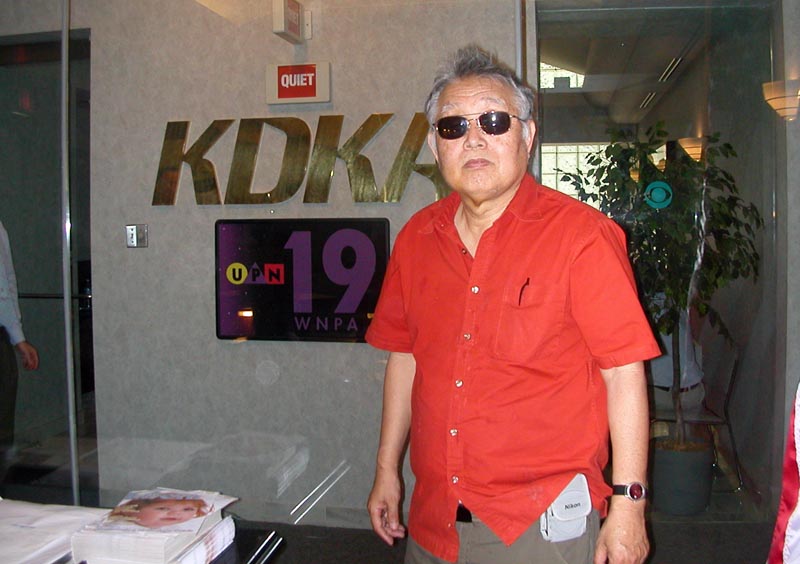
| Inst. of Physics at the Univ. of Rome is named after Marconi (top). Marconi's bust at KDKA, the world's first broadcasting station, in Pittsburgh. |

|
|
|

|
Marconi was a theoretical physicist. When he was a teenager, he studied Maxwell's equations and became determined to test radiation and propagation of electromagnetic waves, while nobody believed he would be successful. He received the Nobel prize in physics in 1909. Needless to say, Marconi was an exceptional experimentalist. He was also an excellent businessman. After coming to the United States in 1900, he established a wireless communication company. He is also responsible for discovering the "ceiling" in the upper-atmosphere which reflects electromagnetic waves.
In addition, Marconi was an expert on women. While doing his business in New York, he had many mistresses. Since he could not entertain all of them at the same time, he had to hire messenger boys who would carry to them flowers and personal notes from Marconi. At the age of 15, David Sarnoff was one of Marconi's messenger boys. These days, when you drive from the main campus of Princeton University to its Plasma Physics Laboratory, you will see the sign "David Sarnoff Research Center" on your right-hand side. We will talk more about him later in this mail.
I am writing this article because Koreans may and should take a leading role in the second wireless century. Our multinational business firms are doing well in the world market. All they need is the "brain," and our physicists are going to make up this deficiency.
I would also like to stress that the network business is strictly a matter of professionalism, and it is not politics. Many people send me suggestions about what we should do about the future of our network, and most of them express their greed for "gamtu." You should not talk about gamtus to a surgeon in his/her operating room, nor to a banker working on his investment strategy. On the other hand, I would like to encourage our young people to learn from me about the network system. It is an exciting business! In the 21st century, the person who controls the information flow will control the world. I am already working with some of our most brilliant Koreans. Please join our team and contribute your ideas.
Let us now get into the main story. Marconi's ideas indeed flourished in the United States. In a relatively short period after coming to New York in 1900, Marconi established a company selling communication equipments to ocean-going ships. His company also handled trans-Atlantic telegraphs. While he was showing his success, three Americans got on the bandwagon. They were Lee de Forest, Howard Armstrong, and David Sarnoff.

In the 1950s, a new revolution started taking place in electronic industry. Transistors!! This revolution is still going on.
Let us now look at the history of Korea's wireless communication. After the United States decided to join World War I, all three of the above- mentioned Americans, together with their equipments and labs, became mobilized to the war effort. While this was going on, one of the newspaper companies in Pittsburgh developed the idea of news broadcast using this new wireless communication system.
|
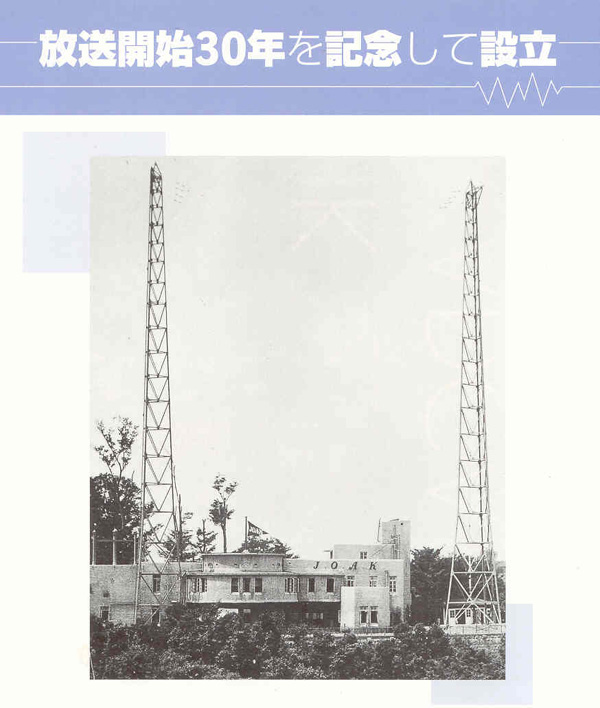
While this was going on in the United States, Japanese installed their first broadcasting station in Tokyo in 1925. They also developed the network system called NHK (Japan Broadcasting Association). At that time, Korea was under the Japanese rule, and Japanese authorities extended the NHK network to the Korean peninsula resulting in a broadcasting station in Seoul in 1927, one year after Sarnoff completed his network system in the United States. The Seoul radio station (now called HLKA) was called JODK, while the Tokyo station was called JOAK. Before Seoul, the Japanese government installed two more broadcasting stations in Japan, one in Osaka (JOBK), and the other in Nagoya (JOCK).
After 1945, the Seoul Station became Korea's central broadcasting station (now called KBS) with an output of 50 kilowatts, enough to cover the entire peninsula and southern Manchuria. Its AM frequency was 0.97 MHZ. Pyongyang had a 10-kw station with its AM frequency 1.01 MHZ. It was possible to hear Radio Pyongyang in Seoul. On the other hand, other stations in Korea had outputs of 500 watts or less. For instance, Pusan had a 500-watt station barely enough to cover the city. When North Korean forces captured Seoul in June 29, 1950, the communists had two major stations talking loudly. The South (or UN) had to borrow transmitters in Japan to cover the entire country. The citizens of Seoul, while under the communist rule, heard the voice from the South, but they did not know the radio waves were coming from Japan.
The FM technique was invented by Armstrong before WWII, but David Sarnoff suppressed the FM network in an attempt to dump him. For this reason, the FM radio did not become popular in the United States until the 1950s. However, Koreans picked up the FM techniques immediately after 1945. On August 19, 1949, the Korean Navy had its naval show near a small island about 10 kilometers away from Inchon. This was of course a part of the annual 8.15 celebration. Korea's combat fleet consisted of ten US-built mine sweepers each equipped with one 37 mm gun. It was a typical bath-tub navy, but this event was important enough for the broadcasting station to give a live coverage. I was on one of the two observation ships. President Rhee and his Austrian-born wife were on the other ship (more luxurious of course). The live broadcast was sent from the observation ship to Seoul's main station via FM. This was the first application of Armstrong's FM technology in Korea.
|
While Korean engineers were quite up to date on new technologies, the radio programs were far behind. This is why I continued monitoring Japan's NHK programs using my short wave equipment. Of course, the Japanese radio people were not idle in developing new techniques. In 1953, they tried a stereo broadcast using two separate AM transmitters. This was a stupid idea in view of the FM stereo technology available today. Yet, it was an idea worth trying at that time. In July 1953, NHK's Tokyo station used its two AM stations (JOAK1 and JOAK2) to broadcast Suwa Nejiko's performance of violin concerto No. 3 by Saint Saens. The short wave version was still monophonic, and I recorded her historic performance using my high-school's tape recorder [at that time tape recorders were extremely rare and expensive]. I often tell this story to my Japanese friends to impress them, and they indeed become impressed.
 Why is Ms. Suwa so important? There are three Japanese personalities
responsible for reconstructing their morale after the disastrous defeat
in the Pacific War. The first one is Yukawa Hideki (Nobel 1949), the
second one is Misora Hibari (pop singer; her grandfather was a Korean),
and the third Suwa Nejiko. Suwa studied in France, and became the first
world-class violinist from Japan. The performance I recorded was her
first one in Japan after a triumphant return from France. If you are
a Korean, cheer up! These days, our Chung Kyung-Wha is the best player
of Saint Saens!
Why is Ms. Suwa so important? There are three Japanese personalities
responsible for reconstructing their morale after the disastrous defeat
in the Pacific War. The first one is Yukawa Hideki (Nobel 1949), the
second one is Misora Hibari (pop singer; her grandfather was a Korean),
and the third Suwa Nejiko. Suwa studied in France, and became the first
world-class violinist from Japan. The performance I recorded was her
first one in Japan after a triumphant return from France. If you are
a Korean, cheer up! These days, our Chung Kyung-Wha is the best player
of Saint Saens!
I have been interested in electronic communications since my high-school days. This is why I have been able to develop one of the respected computer communication systems in the physics community. The question then is what it has to do with physics. This is my ultimate weapon with with I can make my original work known to the world and with which I can protect myself against possible professional piracy.
Addendum: Korea's Electric Power Generation
Very often these days, we hear about the nuclear power stations to be built in North Korea. They are talking about constructing two stations each with an output of 1,000 megawatts. The combined output will be 2,000 megawatts. How does this compare with the figures familiar to us? The total capacity in the South appears to be approximately 30,000 megawatts. During the last summer (unusually hot), the consumption rate was as much as 25,000 megawatts.In 1945, the total capacity in the entire peninsula was approximately 850 megawatts, including the 600 megawatt facility in the Soopung hydro station. Three days before the 5.10 election in 1948, North Korean authorities cut off the power supply to the South. The South at that time was not able to produce more than 60 megawatts, including the output from the generating ships "Jagona" and "Electric" hastily brought from the United States. The Hwachun hydro station with capacity of 50 megawatts was and still is located north of the 38th parallel, but it now belongs to the South. When I left Korea in 1954, the South's total capacity was approximately 150 megawatts. The capacity grew to 300 megawatts toward 1960.
When I was riding the bus from Princeton to New York through New Jersey Turnpike around 1960, I used to see a small oil-burning station with a sign saying "Linden Power Generating Station - Output 350,000 Kilowatts" (= 350 megawatts). I used to get distressed to note that this single station could generate more power than one country (that happened to be mine) could. Since then, Koreans did very well in building power stations. These days, more than 50% of the total output comes nuclear stations.